Articulation Office
What is articulation?
Articulation is the process of evaluating courses or a sequence of courses to determine whether a specific course offered by one educational institution (e.g., Napa Valley College) will meet the requirements for admission, transfer credit, general education, or lower-division major preparation at another institution (e.g., UC Davis).
The Articulation Office supports staff and students in comparing the content of courses transferred between postsecondary institutions. This process results in an articulation agreement. Articulation agreements are formal partnerships between two or more colleges, typically between a community college and a four-year university.
These agreements may also cover the transferability of coursework between community colleges. They document a clear pathway from one program to another at different institutions. In simpler terms, these partnerships make it easier for students to transfer from one school to another, ensuring that their credits will be accepted. Articulation agreements facilitate seamless transfers between institutions, helping students avoid the loss of credits in the process.
Transfer Institution Articulations
For students looking to transfer to a California State University (CSU) or University of California (UC), CSU and UC transferable courses and course-to-course articulations for lower-division major preparation can be found at ASSIST.org.
To find information on articulation agreements between Napa Valley College and private or independent college or universities, please visit our Articulation Agreements page.
common course numbering
What is Common Course Numbering?
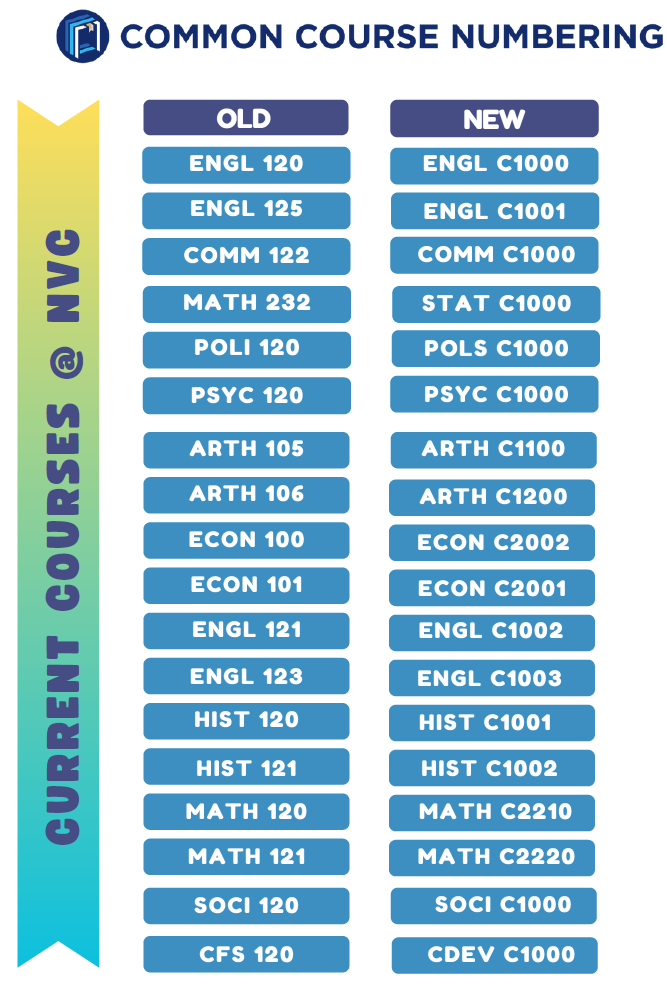
The Common Course Numbering (CCN) system provides a streamlined and consistent approach to course numbers and titles across California Community College systems.
Why is Common Course Numbering being introduced?
The primary purpose of CCN is to create a student-friendly system for course registration and credit transfers. By standardizing course numbers and titles across California Community Colleges, CCN reduces confusion, supports academic planning, and enables smooth transitions between colleges and universities.
When does Common Course Numbering begin?
You’ll first begin to see Common Course Numbering when the schedule of classes is released in early April 2025. The first semester for implementation is Fall 2025. Students who take classes in the Fall 2025 will be registered in courses with the common designations.
Who is Common Course Numbering for?
Common Course Numbering is for all students enrolled across California’s public systems of higher education. The CCN implementation begins with a small group of courses, so not all students will immediately notice the change in course numbering.
How will Common Course Numbering benefit the student experience?
As noted, Common Course Numbering will simplify the process for students to take — and earn credit for — classes at multiple institutions and foster easier transfer from the California Community Colleges to University of California and California State University campuses. In addition to simplified transfer and reduced redundancy, Common Course Numbering also clarifies course progression to streamline the process of earning degrees.
Curriculum Implementation Status (Recording)
COCI Submissions and Technology Implementation (Recording)
Funding, Reporting and Phase II Template Implementation (Recording)
Student Facing Communication (Recording)
April 2025 through June 2025 CCN Update (PDF)
See other updates on the official CCN site.
Contact Us
- (707) 256-7333
- Building 1300, Room 1335
-
Monday-Thursday online
8 am to 3 pmFriday
8 am - 12 pm
- Stacey Howard
Articulation Officer and Professor of Counseling - showard@napavalley.edu
- Contact Online
-
Michelle Hinchcliff
Administrative Assistant of the Transfer Center & Articulation Office